
Previous experience of GBM includes working with WWF, well known for the panda logo and its work to protect endangered species. But that was just one part of the complex conservation jigsaw. The world’s largest independent conservation organisation founded in 1961 is one of the most trusted brands and had the credibility to solve some of the broader environmental issues in the eyes of its audiences. WWF was working on solutions to some of the world’s biggest environmental challenges – like reducing carbon dioxide emissions contributing to climate change and reducing deforestation. It was important to engage with two key audiences for WWF:- the general public and business, to ensure that they understood the broader remit of its work.
The segment of the general public identified was already very concerned about the environment but currently weren’t members of any environmental NGOs. They thought that the solutions to these complex problems were impossible to find and the media coverage was seen as depressing and off-putting. So first and foremost they didn’t need to be ‘sold’ the importance of the environmental issues but rather given a window to support them.
For business we needed to position WWF as the essential environmental organisation to consult or partner in the pursuit of sustainable solutions, with a mainstream business audience.
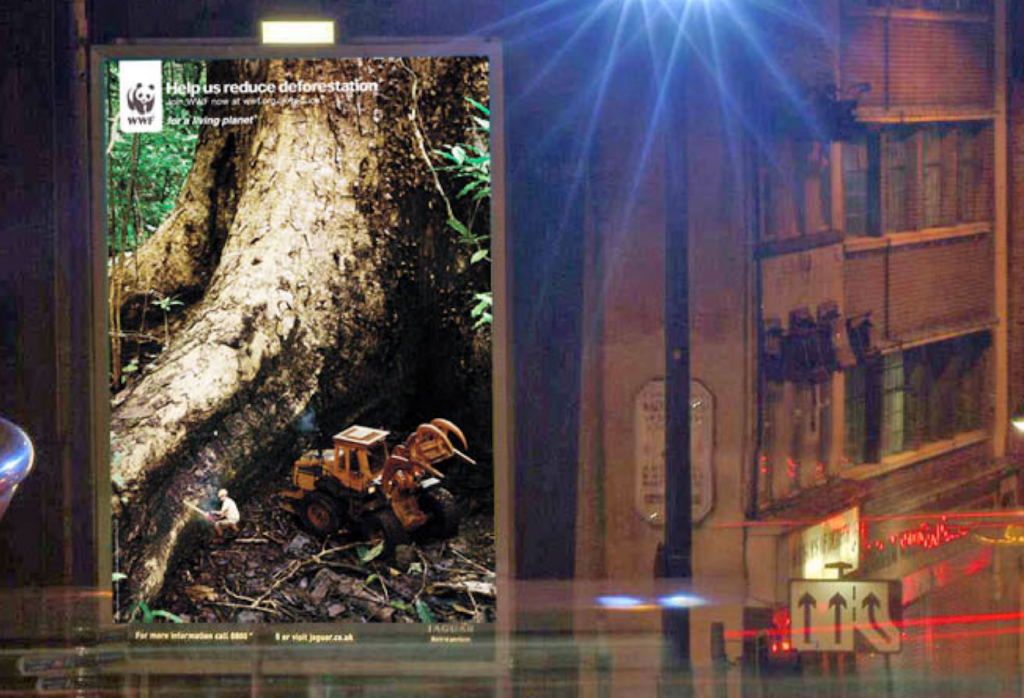
Campaigns were devised that targeted both groups by focussing on the solutions, which were seen as far more motivating, and the messaging was about two of the major environmental threats – C02 emissions and deforestation. These two issues were also priority areas of work for WWF and research showed that the public (and business) were particularly concerned about climate change and deforestation.
The aim was to demonstrate that increased influence with government and business could make a difference. We wanted to show that people could make a big difference to the environmental issues themselves.
We ran a regional multi-media campaign. Posters, radio and events were used to reinforce the message, along with a dedicated website, featuring stories about WWF’s work, a planet hero quiz, information on what people could do to help reduce environmental problems, and the opportunity to join WWF.
An extensive PR campaign was used to bring the campaign alive, including a feature where a family affected by the Birmingham Tornado in 2005, met a family from Boscastle, previously affected by the flooding in Cornwall. Also a WWF survey was conducted showing that over 85 per cent of people in Birmingham were increasingly worried about the impacts of global warming which gained media coverage.
Partnerships were a critical part of the campaign delivery with support from HSBC, Ben & Jerrys and Canon.
The campaign resulted in increased awareness of WWF as an environmental organisation. And importantly consideration to support amongst those who saw the campaign increased by 17% with 1,000 new members.
The positive affects of the campaign were useful in developing relationships with current partners as well as developing new partnerships with Disney, and ITV’s Extinct series.
In the business community, we achieved an increase in familiarity rating amongst business leaders up by 5% as a result of the whole campaign to target business leaders.


